Showing posts with label genealogical research. Show all posts

Saturday, August 26, 2017

What do I do with my Y-DNA results?

I ordered a 37-marker Y-DNA test for my brother in 2005 to see if we could extend the Thompson line with DNA. Let's examine what to do when you take a Y-DNA test.

When you first order the test, you will be given a kit number and password. You will use this to access your results online. But it is not obvious what to do when you get your results. You will see this section on your account page:


What do I do with all of that?  Where are my results, and what do I do with them?  Let's first click on the Y-STR Results (the 8th item above).

What does the term Y-STR mean?  The STR test is the first Y-DNA test that you order at Family Tree DNA. STR stands for Short Tandem Repeat. A Short Tandem Repeat means that a short series of bases (nucleotides) is repeated side-by-side several times, something like a hiccup.

Here's an STR example: AGATAGATAGATAGATAGATAGATAGATAGAT. In this example, the sequence "AGAT" is repeated 8 times. There are many known locations on the Y-chromosome where these Short Tandem Repeats occur. Each of these locations is identified by a marker. 

The Thompson DNA test was a 37-marker test, so Family Tree DNA examined 37 locations on the Y-chromosome and reported the number of repeats. 

The first location was identified with the marker DYS393 which is DNA Y-chromosome Segment 393. At this marker the number of repeats was counted and reported--my brother had 13 Short Tandem Repeats at the location DYS393. Here are the complete results:
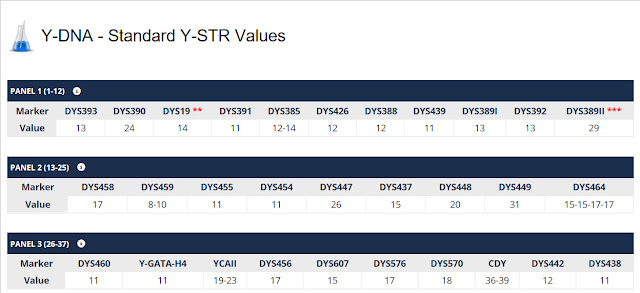
Family Tree DNA Y-DNA results

If that's all we got, the results would be useless. The entire purpose of DNA testing is to see who matches you. 
So the good news is that you don't need to understand or remember any of the information about STRs to use Y-DNA. You need to see who matches you, find out exactly how they match, compare family trees, and find additional people to do DNA testing to prove your theories.
Family Tree DNA has a database that finds matches for you. We will now look at the Matches icon in the first image above. This is how the results appear today:
Family Tree DNA Y-STR matches

You can see by the Match Date column that in 2005 my brother had only one match. That 2005 match is at the bottom of the list and is a descendant of Augustus M Thompson. This man is not an exact match--we know that because the Genetic Distance Column says that he has a genetic distance of 4. This means that on his 37-marker results he is mismatching my brother by 4 numbers. 
Again, that's not very useful unless we know which markers he is matching and which ones he isn't. For that, the first place you will turn is to your surname project because all of the results will be displayed there. If your match has not joined your surname project you will want to contact him by email.
The links that appear below each name will provide a way to contact the person, view his family tree if he has submitted one, and more.

We will examine various other issues (like why are there all those other surnames on the list like Akins, Barton, Brown, . . . ?) in subsequent blog posts, but for the next one let's head to the surname project to see if we can make sense of all of this. See Surname Projects: Examining my first Y-DNA match.

Thursday, August 24, 2017

Finding the father of Electious Thompson

For decades, all I've known is that my direct paternal line ends with a man named Electious Thompson who was born 1750 in Maryland and died in Morgan County, Alabama, in 1840.  

I lived in Northern Virginia for many years, and I made countless trips to the National Archives and to various Maryland archives and libraries to see if I could find the name of his father. Electious had lived long enough to collect a pension for his Revolutionary War service, so I read his pension application for clues. I went through land records, church records, probate records, and anything else I could find. All to no avail.

A tribute to Electious (spelled "Electius" in the newspaper) was published in the Huntsville Democrat July 17, 1841. It began:

THOMPSON, ELECTIUS-"We are assembled, on this interesting occasion, around the grave of Electius Thompson, a revolutionary father, to pay to his memory the last tribute of respect.
 "But we hasten to give you a brief sketch of Electius Thompson. He was born in 1750, near the place where the city of Washington now stands, and died at the advanced age of ninety years. Losing his father when an infant, he was committed to the charge of an uncle, who placed him on a vessel at sea at the early age of nine years, to learn the arduous duties of a sailor. . . ."

Family tradition states that the father of Electious was killed at the 1755 defeat of General Braddock in the French and Indian War. Even though the newspaper tribute stated that Electious was born in 1750, I determined that Electious was probably born in 1755 because he was an "infant" when his father died.  However, no matter where we looked, no researchers could determine the father's identity.

Finally, in 2005 I was so frustrated with the search that I decided to try DNA testing. The only tests that were available at the time were Y-chromosome STR tests and mitochondrial DNA tests.  

Mitochondrial DNA (mtDNA) was out of the question because mtDNA is inherited from the maternal line. I didn't have a Y-chromosome, and my male ancestors were all deceased. 

But I did have two brothers, and they should be carrying the Thompson DNA. I decided to test one of my brothers.

I asked my brother if he would take a DNA test for me. He said, "You know I really don't care about that stuff." I replied, "But I do, and I'm willing to pay for the test." He consented.

Could Y-DNA solve a mystery like this? I had to try. There was no other option. We will begin the DNA testing process in the next post by examining What do I do with my Y-DNA results?

Sunday, October 12, 2008

The Ultimate Family Historians

Who are The Ultimate Family Historians? All of us who are now doing genealogy and family history should begin to consider ourselves in this category. That probably includes you.

The term "Family Historian" means more than "Genealogist." To do basic genealogy, you don't have to compile more than the bare facts of birth, marriage, and death. A person who interviews family members and fills out a pedigree chart is beginning genealogy. Family history, however, involves finding out more than just the facts that will fit on a pedigree chart. To do family history we must know, as much as possible, how the people in the family actually lived. Then we record their stories and put meat on the bare bones of genealogy.

Many of us start out as amateur genealogists, and we may not see ourselves as doing any history. When I first started genealogy more than thirty years ago, I was merely trying to compile a long pedigree chart. I started by asking my grandfather some questions. I remember my grandfather telling me some stories about the family, and I thought, "I don't want to hear all of that. I wish he'd just tell me where they were born and the names of their parents." Really! I thought that! Now I want to kick my old self. I wish I would have recorded those stories in more detail.

Then I started getting "serious." Back then, I had to write letters to potential relatives and hope that they responded. I had to write letters and send checks to churches, courthouses, and governmental agencies. Sometimes I would wait for months for a response. Sometimes the response never came. I used to laugh that I was the only person I knew who would get excited by getting a death certificate in the mail.

I compiled my charts, collected whatever facts I could, and received a few photos. Most people didn't want to give up their original photos, and it could be inconvenient and even expensive to make more copies. Often they would send me photocopies of photographs. All of my documents went into file folders. My folders were organized by family surname, but that system wasn't fully adequate. I had to do a lot of cross-referencing.

If they existed, I ordered microfilms of records from the areas where my ancestors lived. I waited weeks for each film to arrive. Because most of the records weren't indexed, I had to roll page by page through every film. When I found an ancestor, I often had to make several paper copies of the record before I would get one that was readable. I spent many hundreds of dollars ordering films and making photocopies. I traveled all over the country to research in courthouses and walk through cemeteries to find tombstones.

Of course, there was really no good way to share each new discovery unless someone happened to find out about me and wrote me a letter requesting information. I conducted thousands of hours of research, and only I could see it.

That was before computers, scanners, digital cameras, the Internet, email, and the many other conveniences we now take for granted. We can locate records in seconds that used to take years to find. Again, in seconds we can find people who are related to us who may live thousands of miles away. We can communicate with them instantly and receive an immediate response. We can send them a digital copy of a photograph that is better quality than the original we have.

We can become The Ultimate Family Historians.

The word "Ultimate" has several meanings. Two of them are:
  • The last in a series or progression
  • The best or most extreme of its kind
I intend to help all of you become The Ultimate Family Historians with both of the above meanings. I'll explain how next.