Showing posts with label family history. Show all posts

Friday, October 6, 2017

Y-DNA STRs, SNPs, and Haplogroups

I used Y-STR testing to trace backward in time to find the father of my ancestor Electious Thompson, born 1750 in Maryland (see Breaking through brick walls with Y-DNA). 

I could not use my own DNA because I do not have a Y-chromosome. So, I asked my brother if he would be willing to test.

With my brother's Y-DNA results I not only found the father of Electious but also his grandfather George and great-grandfather Robert Thompson who died 1697 in Maryland. STR testing can produce amazing results! Here's what I now know:

Thompson genealogy
Paternal line in family tree

But my new brick wall is Robert Thompson. He was the immigrant ancestor. Is it possible to find his origins? 

There are two kinds of Y-DNA tests: STR and SNP. I've gone as far as I can with STR testing and now I need to switch to SNP testing to work forward in time from the ancient haplogroup predicted by Family Tree DNA to a modern haplogroup in the genealogical time frame. We will now examine STRs, SNPs, and haplogroups.


STRs

When you first order a Y-DNA test from Family Tree DNA you will probably be ordering a Y-STR test. I will repeat my explanation of STR testing from my previous blog post.

STR stands for Short Tandem Repeat. A Short Tandem Repeat means that a short series of bases (nucleotides) is repeated side-by-side several times, something like a hiccup.

Here's an STR example: AGATAGATAGATAGATAGATAGATAGATAGAT. In this example, the sequence "AGAT" is repeated 8 times. There are many known locations on the Y-chromosome where these Short Tandem Repeats occur. Each of these locations is identified by a marker. 

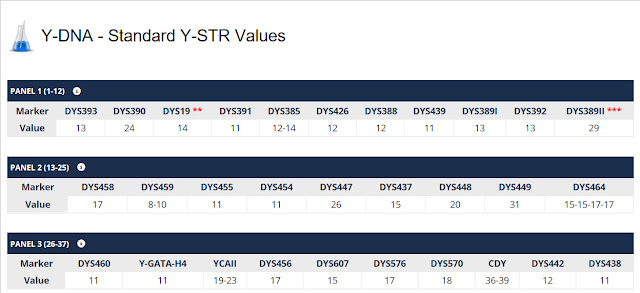
The Thompson DNA test was a 37-marker test, so Family Tree DNA examined 37 locations on the Y-chromosome and reported the number of repeats. 

The first location was identified with the marker DYS393 which is DNA Y-chromosome Segment 393. At this marker the number of repeats was counted and reported--my brother had 13 Short Tandem Repeats at the location DYS393. Here are the complete results:

Family tree DNA Y-DNA results
Y-DNA STR results

These results are meaningless unless they are compared to the results of other men. So in addition to your STR results you will get a list of matches. 
You will also want to join a surname project so that you can compare your results with other people who share your surname. 

I did all of that with the Thompson STRs, and that is how I found Electious Thompson's father. Now I want to go further back in time.


SNPs

When you took your first test, Family Tree DNA did not do any SNP testing on your DNA sample; they only conducted an STR test. 

So what's a SNP? SNP (pronounced "snip") stands for Single Nucleotide Polymorphism. It occurs when a single base (nucleotide) mutates. In the image below the ancestral nucleotide A has mutated to a T in Man 1. [See the fifth letter from the left.]  

Single nucleotide polymorphism and short tandem repeat
Image by Mark Jobling


The main difference between SNPs and STRs is their stability.

STRs can mutate back and forth. For example, in the example above we don't know which of the repeat values came first. Man 1 has CTA repeated 5 times, but CTA is repeated 6 times in Man 2's results and 7 times in Man 3's results. 

Which is the ancestral value--was it first a 5 that changed to a 6 in Man 2 and then a 7 in Man 3? Or was it first a 6 that mutated down to a 5 in Man 1 and up to a 7 in Man 3? Or was it first a 7 that mutated down in Men 1 and 2? There is no way to tell. 

Furthermore, these not the only three options--STRs can mutate up in one generation and back down in another generation making two men look more closely related than they really are.

SNPs, on the other hand, are generally one-time events. When a SNP occurs it is passed down to all future generations. Some SNPs are proven to have occurred thousands of years ago. Others occurred in recent times. 

When a new SNP is found through Y-DNA testing it is given a name and placed on the human Y-DNA tree (called the haplotree). The name of this SNP becomes the name of a new haplogroup. 

A haplogroup is simply a group of men who share a SNP. SNP testing is progressing so rapidly that SNPs occurring in the genealogical time period are being now placed onto the Y-DNA haplotree.


Haplogroups and SNPs

Based on the pattern of your STRs Family Tree DNA will predict an ancient haplogroup. Your haplogroup is your branch on the Y-DNA haplotree. Again, haplogroups are formed when two or more people share a SNP. 

When I first logged into my brother's account many years ago, the haplogroup appeared in the upper-right of the screen.


Family Tree DNA projected haplogroup
Predicted haplogroup


In this example, the predicted haplogroup is R-M269. R-M269 is the most common haplogroup in Western Europe. It is also very old. Here's what Family Tree DNA reports about the age of the SNP R-M269:

Family tree DNA haplogroup R-M269 age


To see where this SNP occurs in the human haplotree, the Y-DNA section of our account contains the following links:

Y-DNA links


When you click "Haplotree & SNPs" you will be taken to your predicted location on the Y DNA haplotree:

R-M269 haplotree
Y-DNA haplotree

My predicted haplogroup of R-M269 at an approximate age of 25,000 years ago is not specific enough to help me find Robert Thompson's origins. But notice that there are many SNPs below R-M269 which will take me increasingly closer in time. The image shows only a tiny portion of the many SNPs that are downstream from R-M269.

If you took a test from 23andMe, you can get a more recent haplogroup than the one predicted by Family Tree DNA. Go to reports, then Paternal Haplogroup, This haplogroup, while not a modern one, has actually come from limited SNP testing.

23andMe Y-DNA SNP testing
Paternal haplogroup at 23andMe


SNP Testing

Family Tree DNA offers three ways to do SNP testing. You can order a single SNP, a group of related SNPs (called a SNP Pack), or a test that will discover new SNPs in your Y-DNA (called the Big Y).

Before the Big Y test was available, I used to look at my matches who had done SNP testing and order a single SNP.  Here is the result of a single-SNP test I took in 2012:

R-DF13 SNP
Single-SNP test refines haplogroup

This brought my haplogroup closer to the present, but it can be an expensive way to go if I periodically order one SNP at a time. 

When I first received my STR results this screen said, "Your Predicted Haplogroup is R-M269." Notice that this screen now says "Your Confirmed Haplogroup is R-DF13." Until further testing, this is considered to be my terminal SNP. 

But I can now get much closer in time than that!

One way to predict your own haplogroup is to look at your matches in your surname project. In the surname projects the haplogroups are color coded. The ones in red are predicted haplogroups--the men with the red R-M269 have not done any SNP testing. The men with green haplogroups have been SNP tested.

projected haplogroup SNP tested haplogroup
Haplogroup project results

Since the two descendants of Electious Thompson have matching STRs to the men who have been SNP tested, they probably belong to Haplogroup R-FGC11134 as well. This SNP is downstream of R-DF13. 

The two men with the R-FGC11134 haplogroup tested with a SNP Pack. Below are the results from an R-M269 SNP Pack. This man was tested for the listed SNPs.  He was positive for the ones that are followed by a + sign. From this test his terminal [most recent] SNP is considered to be FGC11134. 

SNP pack
Results from SNP Panel test

Here's another way to find a more modern haplogroup than your predicted one. Check your list of matches and look at the Terminal SNP column. Two men were SNP tested for R-FGC11134.


Y-DNA match list
Y-DNA match list

So now we will join the R-FGC11134 Project to see if we can find other men who may be related more distantly than the Thompson Project members. 

Remember, we are trying to find the ancestors of Robert Thompson, and this will mean looking at other surnames to find clues to our European origins. Instead of working backward in time to find our common ancestor (as we did with STR testing), we now want to start with R-FGC11134 and work forward in time.

To join a project, log into your FTDNA account. Click Projects, then Join a Project.

join Family tree DNA projects
Join a project


Then scroll down to Y-DNA Haplogroup Projects.                        


join Family Tree DNA haplogroup projects
Y-DNA haplogroup projects


R-FGC11134 will be found under the letter R.

join Family Tree DNA haplogroup project
Join a Project


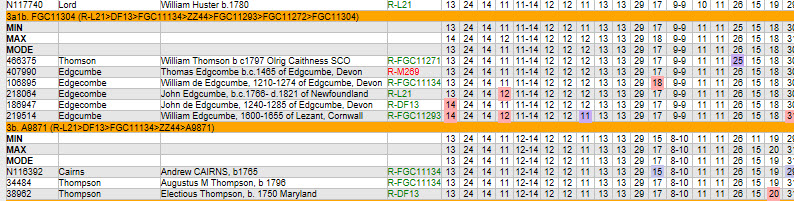
Once you have joined a haplogroup project, the project administrators will usually put you into a subgroup. Based on STR results, the FGC11134 Project administrators placed the two Thompsons with a man named Cairns. A man named Thomson was placed with a group of Edgecombes. Is this correct?


haplogroup project grouping
Haplogroup project grouping

Cairns does not show up on my brother's list of DNA matches. Family Tree DNA has a set of cutoffs for what it considers to be a match. For 37 markers the match must be no greater than a genetic distance of 4, at 67 markers the match threshold is 7 and at 111 it is 10. 

The distance between Cairns and either of these two Thompsons is greater than the FTDNA threshold, and he also doesn't share the same surname. Only through the haplogroup project does he show as a potential match. 

Cairns and Thompson share an interesting combination of STR results that are not seen in any other groups: these include 12-14 at DYS385, 8-10 at DYS459, and especially 11 at DYS438 [everyone else in the entire haplogroup project has a 12 in this position].

We know that Cairns and Thompson share a common ancestor because they share the SNP FGC11134. But could they be even more closely related and share some recent SNPs?  

I suspected that based on the shared STRs they might share a few undiscovered SNPs. It turns out that Cairns had taken the Big Y test and had a long list of newly-discovered SNPS not shared with anyone else. Could Thompson and Cairns form a new haplogroup?

Testing with a single SNP or a SNP Pack cannot answer this question because these tests only look for known SNPs. On the other hand the Big Y is a SNP discovery test. It will look across the Y chromosome searching for both known and new SNPs.

It was time to stop messing around with single SNP testing and order the Big Y. Click Upgrade in the upper-right of your account screen.

Upgrade test results


All I can say is that I was blown away by what I saw when the results came back. Hang on! You'll next see why I say:
The Big Y test from Family Tree DNA can knock your socks off!


______________________________________________________
Disclosure

Links to Family Tree DNA appear in the sidebar. I receive a small contribution if you make a purchase, but clicking through the link does not affect the price you pay. 


Monday, August 28, 2017

Surname Projects: Examining my first Y-DNA match

After I ordered a Y-DNA test from Family Tree DNA, I wanted to join a surname project.  I should have joined the project before ordering the test because I would have gotten a discount on the test.  So after receiving my results, how did I join the Thompson DNA Project? Here's the general procedure. Log into your account, then click Projects>Join a Project.


On the next page you will first see a section called Matching Projects. This is a list of projects that include your surname. Some of these projects will be relevant to you, but some will  not.


Click the name of the project you wish to join. The Thompson surname project appears on my Matching Projects list.


If you want to see other projects go to the bottom of the Matching Projects section to see all projects. There are even more sections which are not shown in the image below.


You will want to become very familiar with this process because you will be joining multiple projects to get the most from your DNA results.  It does not cost to join any projects, so you can join as many as you wish. If you wanted to find the Thompson surname project you can see that there are 296 surname projects that start with the letter T.  Click on T:


Then go through the alphabetical list of surnames. You may need to check variant spellings. Now we will click on Thompson.


You can click the website link to see the project before you join, or just click the orange Join link to become a member of the project. Some projects screen participants before they join, but most do not.


So now we're in the Thompson project. You will immediately appear in the project, but your placement within the project may change after your project administrator looks at your results. You can access any of your projects by going to Projects>Manage My Projects.


The first project I joined was the Thompson project, but over the years I have done more testing and have joined multiple projects for my brother's kit:


Ok, now let's click on the Thompson project! The Thompson surname project has more than 1000 members (and some projects have many more), so it can be bewildering at first. My kit does not appear anywhere on the page below. In the image the arrow is pointing to the page size which is automatically set to 500.  I need to change the page size if I want to see everyone on the same webpage, or I can click page by page until I find my results.


I will reset the page size to 1200:


Now I can find my kit!  When I first started I had tested 37 markers and had only one match. Here is how it looked [The only difference from the results screen below and the original results is the Haplogroup column because we have both now been SNP tested--I have done the BigY test and the other man has tested an FTDNA SNP pack. We will examine what that means in a future post.]


If you refer to my previous blog post, What do I do with my Y-DNA results?, you will see that Family Tree DNA stated that my brother was a genetic distance of 4 from the man who descends from Augustus M Thompson. We can now see what that means. These two kits are mismatching by one number each at four locations: DYS448, DYS456, DYS576, and CDY. If they were very closely related there might be no mismatches. At a genetic distance of four at 37 markers, this is at the edge of what Family Tree DNA considers to be a match. So this does not appear to be a close match.  I tried very hard to find our genealogical relationship, but even though I've been doing genealogy for decades and even do it professionally I could not find our common ancestor. Our common ancestor was further back than my Electious Thompson.

How frustrating! What now? I had to hope that other Thompsons would test, and I even had to recruit some myself. We will next look at this process in the next post, Setting up for great DNA matches. We will then see the amazing power of Y-DNA testing.

Saturday, August 26, 2017

What do I do with my Y-DNA results?

I ordered a 37-marker Y-DNA test for my brother in 2005 to see if we could extend the Thompson line with DNA. Let's examine what to do when you take a Y-DNA test.

When you first order the test, you will be given a kit number and password. You will use this to access your results online. But it is not obvious what to do when you get your results. You will see this section on your account page:


What do I do with all of that?  Where are my results, and what do I do with them?  Let's first click on the Y-STR Results (the 8th item above).

What does the term Y-STR mean?  The STR test is the first Y-DNA test that you order at Family Tree DNA. STR stands for Short Tandem Repeat. A Short Tandem Repeat means that a short series of bases (nucleotides) is repeated side-by-side several times, something like a hiccup.

Here's an STR example: AGATAGATAGATAGATAGATAGATAGATAGAT. In this example, the sequence "AGAT" is repeated 8 times. There are many known locations on the Y-chromosome where these Short Tandem Repeats occur. Each of these locations is identified by a marker. 

The Thompson DNA test was a 37-marker test, so Family Tree DNA examined 37 locations on the Y-chromosome and reported the number of repeats. 

The first location was identified with the marker DYS393 which is DNA Y-chromosome Segment 393. At this marker the number of repeats was counted and reported--my brother had 13 Short Tandem Repeats at the location DYS393. Here are the complete results:

Family Tree DNA Y-DNA results

If that's all we got, the results would be useless. The entire purpose of DNA testing is to see who matches you. 
So the good news is that you don't need to understand or remember any of the information about STRs to use Y-DNA. You need to see who matches you, find out exactly how they match, compare family trees, and find additional people to do DNA testing to prove your theories.
Family Tree DNA has a database that finds matches for you. We will now look at the Matches icon in the first image above. This is how the results appear today:
Family Tree DNA Y-STR matches

You can see by the Match Date column that in 2005 my brother had only one match. That 2005 match is at the bottom of the list and is a descendant of Augustus M Thompson. This man is not an exact match--we know that because the Genetic Distance Column says that he has a genetic distance of 4. This means that on his 37-marker results he is mismatching my brother by 4 numbers. 
Again, that's not very useful unless we know which markers he is matching and which ones he isn't. For that, the first place you will turn is to your surname project because all of the results will be displayed there. If your match has not joined your surname project you will want to contact him by email.
The links that appear below each name will provide a way to contact the person, view his family tree if he has submitted one, and more.

We will examine various other issues (like why are there all those other surnames on the list like Akins, Barton, Brown, . . . ?) in subsequent blog posts, but for the next one let's head to the surname project to see if we can make sense of all of this. See Surname Projects: Examining my first Y-DNA match.

Thursday, August 24, 2017

Finding the father of Electious Thompson

For decades, all I've known is that my direct paternal line ends with a man named Electious Thompson who was born 1750 in Maryland and died in Morgan County, Alabama, in 1840.  

I lived in Northern Virginia for many years, and I made countless trips to the National Archives and to various Maryland archives and libraries to see if I could find the name of his father. Electious had lived long enough to collect a pension for his Revolutionary War service, so I read his pension application for clues. I went through land records, church records, probate records, and anything else I could find. All to no avail.

A tribute to Electious (spelled "Electius" in the newspaper) was published in the Huntsville Democrat July 17, 1841. It began:

THOMPSON, ELECTIUS-"We are assembled, on this interesting occasion, around the grave of Electius Thompson, a revolutionary father, to pay to his memory the last tribute of respect.
 "But we hasten to give you a brief sketch of Electius Thompson. He was born in 1750, near the place where the city of Washington now stands, and died at the advanced age of ninety years. Losing his father when an infant, he was committed to the charge of an uncle, who placed him on a vessel at sea at the early age of nine years, to learn the arduous duties of a sailor. . . ."

Family tradition states that the father of Electious was killed at the 1755 defeat of General Braddock in the French and Indian War. Even though the newspaper tribute stated that Electious was born in 1750, I determined that Electious was probably born in 1755 because he was an "infant" when his father died.  However, no matter where we looked, no researchers could determine the father's identity.

Finally, in 2005 I was so frustrated with the search that I decided to try DNA testing. The only tests that were available at the time were Y-chromosome STR tests and mitochondrial DNA tests.  

Mitochondrial DNA (mtDNA) was out of the question because mtDNA is inherited from the maternal line. I didn't have a Y-chromosome, and my male ancestors were all deceased. 

But I did have two brothers, and they should be carrying the Thompson DNA. I decided to test one of my brothers.

I asked my brother if he would take a DNA test for me. He said, "You know I really don't care about that stuff." I replied, "But I do, and I'm willing to pay for the test." He consented.

Could Y-DNA solve a mystery like this? I had to try. There was no other option. We will begin the DNA testing process in the next post by examining What do I do with my Y-DNA results?

Wednesday, August 23, 2017

Y-DNA Testing

I am going to start a long process of showing how to solve ancestry with Y-DNA. Unfortunately, you don't have a lot of choices with Y-DNA like you do with autosomal DNA. There is only one company that does Y-DNA testing and also has a large matching database. It is Family Tree DNA.

The Y-chromosome is only carried by men; that's what makes them males. So only men can do Y-DNA testing. What can women do? Test your father, brother, male cousin, etc. 

The Y-chromosome is passed from father to son, so it is a fantastic test to use for finding the origins of your birth surname. This test will help you find your father's father's father's father . . . which is the top line of a horizontal pedigree chart or the left line of a vertical pedigree chart.

Y-DNA paternal line
Y-DNA inheritance


Y-DNA testing has radically changed in the past couple of years because you can now use two different tests to trace your paternal line: an STR (Short Tandem Repeat) test, and an SNP (Single Nucleotide Polymorphism) test. 

For many years, only STR testing was useful for genealogy, and SNP testing was for deep ancestry. But that changed at Family Tree DNA when they introduced the BigY test a few years ago. The BigY is a SNP discovery test which means that it finds new SNPs in your Y-Chromosome. So now SNP testing has moved into the genealogical time frame.

Ultimately, you will want to do two different tests to solve your paternal ancestry, an STR test and an SNP test. You will order the STR test first. To get the best price on your STR test, go to familytreedna.com (or ftdna.com) and join a project before ordering your test. Family Tree DNA gives a discount on the first test to project members.

Join a surname project at Family Tree DNA


You will order the Y-37, Y-67, or Y-111 test.  Each of these tests a certain number of locations on the Y-chromosome, so the Y-37 tests 37 different locations, the Y-67 tests 67 locations, etc. The Y-111 is, by far, the best test because obviously more testing is better than less. But because Family Tree DNA will store your DNA you can start with the Y-37 or Y-67 and upgrade later.

I will show how all of these tests work in subsequent blogs. Hang on! It's going to get amazing. We will start with trying to solve a mystery and then show each step in the progression. So next see Finding the Father of Electious Thompson.

Monday, July 21, 2014

Online Family Trees

When recording the lives of your ancestors, it is essential to have at least two online family trees.  I always knew it was a great idea for everyone else, but for many years I resisted doing this myself.  I had traveled to numerous courthouses, spent countless hours in libraries, etc., and I was not about to let anyone else steal MY research.  I also knew that there might be errors, and I didn't want anyone copying my errors from tree to tree.

Several years ago I decided to try posting a private tree to Ancestry.com containing just a small portion of my ancestry. It was so easy to search census and many other records, because Ancestry did it for me through their "shaky leaf" hint system.  The tree was easy to use, and I could access it from anywhere that I had an Internet connection. But then I decided to see what happened when I made my tree public. All I can say is WOW!  Yes, people copied my information from tree to tree, but they also found additional information that I copied.  Occasionally someone would catch an error.  When I corrected the error, I noticed that the other trees would, one-by-one, get changed to contain the new correction.  The best part came one day when a researcher had noticed a family Bible for sale on eBay.  She searched Ancestry.com public trees for the ancestor's name and found my tree.  She notified me that the Bible of one of my ancestors was for sale. I won the auction and am now the proud owner of a Bible published in the 1700s. I never again wanted any private trees.

If you are going to have any DNA testing (and I hope to encourage you to do so), online trees are essential. I find almost all of my DNA cousins through Ancestry.com, and my greatest discoveries have been made by comparing Ancestry public member trees. Almost everyone who is serious about their DNA research has a tree there.

There is no such thing as too many family trees. Post your ancestry on as many sites as you wish,but these two sites that are critical: Ancestry.com and FamilySearch.org. Here are why these two are important.

Ancestry.com is the best known website for family historians and genealogists.  Ancestry has a massive subscription base, and most subscribers have their own family trees there.  Once you start a family tree, you can search Ancestry's databases for records and attach the records to your ancestor's profile.  Ancestry even searches the most popular 20% of their databases and reports "hints" on your ancestor's profiles. Note that they do not search all of their databases, so you will want to do your own searching.  You can add photos, documents, and stories of your own to the tree.  And best of all, you can search other public member trees where you will find relatives who have these items about your ancestors.  I can't tell you how many great photos and other items I have received from distant cousins whom I never knew existed. All living people appear on Ancestry's trees as "Private", so their names and other information are not searchable.

FamilySearch.org is a well established website, but its newest tree system, FamilySearch Family Tree, has only been around for about a year.  Instead of each person having his own tree at FamilySearch, everyone works on a common family tree. That means that we are not duplicating efforts. When you find a 1850 census record and attach it to the correct family, it never has to be found again.  Everyone will see the new record on the tree. The same applies when someone adds a photo or story to an ancestor's profile.  If someone adds a photo of one of your ancestors, you will not have to find it.  It will appear in your tree.

Please note that you cannot search for, or find, any living person at FamilySearch Family Tree.  Even if you give me your full name, date of birth, and ID number in the system, I still can't find you.  Even my own children can't find me on FamilySearch, so I can still tell them I'm 29 years old! All deceased people should appear in the tree only once, but because living people are not searchable, they may be entered into the tree multiple times. Each person adds all living family members to their portion of the tree so that they can view them. Once you've added your living family (who are visible only to you), you can search for the deceased family members and connect them to your tree.  FamilySearch's collection of digitized and indexed records is available directly from FamilySearch Family Tree, so you can connect them to your ancestor's profile.  In addition, you can add your own photos, documents, and stories.

If you do not have a family tree at one or both of these sites, I cannot encourage you strongly enough to do so.  Each system have different records and different technology.  You will leave a lasting family legacy by using both systems. You can create a tree for free at Ancestry.com, but searching their records requires a subscription.  Everything at FamilySearch is free, just create an account and get started.


Sunday, March 24, 2013

Long Time, No Hear

I started this blog years ago with great intentions.  But life took a turn, and I could barely cope with my own thoughts, much less get them out to others.  So what was the big turn? Divorce.  I had been married for 34 years, had eight children (who are now grown), and my last daughter graduated from high school.  Then my husband walked out.  I went through a deadly painful year-and-a-half divorce process and wondered, "What do I do with myself now?" 

While going through the divorce, I went back to school and studied more history.  I also studied some Chinese because I had a grandson who lived in China and spoke very little English. I was taking such a heavy course load and writing so many papers, that I had little time to think about what I was going through.  Of course, digging up and completing all the legal papers didn't help, but I still managed to ace all those classes.

Then it was time to move out of the house where I had thought I'd spend the rest of my life.  As I packed up years of memories and tried to decide what I should take and what I should leave, I thought I'd lose it. I left with a friend and moved to Texas.

One of my sons contacted me and said, "Mom, why don't you come live with me in China?  You need to get away. I said there was no way I'd do that to my daughter-in-law, Emily. She got on the phone and asked me to come.  I asked, "Do you really want your mother-in-law living with you?"  She said, "Of course! I think it will be fun!"  I thought, "I'm about the furthest thing from fun right now." But I packed again and moved to China. I'll talk about China and how it changed my views of family history in my next post.

Sunday, October 12, 2008

The Ultimate Family Historians

Who are The Ultimate Family Historians? All of us who are now doing genealogy and family history should begin to consider ourselves in this category. That probably includes you.

The term "Family Historian" means more than "Genealogist." To do basic genealogy, you don't have to compile more than the bare facts of birth, marriage, and death. A person who interviews family members and fills out a pedigree chart is beginning genealogy. Family history, however, involves finding out more than just the facts that will fit on a pedigree chart. To do family history we must know, as much as possible, how the people in the family actually lived. Then we record their stories and put meat on the bare bones of genealogy.

Many of us start out as amateur genealogists, and we may not see ourselves as doing any history. When I first started genealogy more than thirty years ago, I was merely trying to compile a long pedigree chart. I started by asking my grandfather some questions. I remember my grandfather telling me some stories about the family, and I thought, "I don't want to hear all of that. I wish he'd just tell me where they were born and the names of their parents." Really! I thought that! Now I want to kick my old self. I wish I would have recorded those stories in more detail.

Then I started getting "serious." Back then, I had to write letters to potential relatives and hope that they responded. I had to write letters and send checks to churches, courthouses, and governmental agencies. Sometimes I would wait for months for a response. Sometimes the response never came. I used to laugh that I was the only person I knew who would get excited by getting a death certificate in the mail.

I compiled my charts, collected whatever facts I could, and received a few photos. Most people didn't want to give up their original photos, and it could be inconvenient and even expensive to make more copies. Often they would send me photocopies of photographs. All of my documents went into file folders. My folders were organized by family surname, but that system wasn't fully adequate. I had to do a lot of cross-referencing.

If they existed, I ordered microfilms of records from the areas where my ancestors lived. I waited weeks for each film to arrive. Because most of the records weren't indexed, I had to roll page by page through every film. When I found an ancestor, I often had to make several paper copies of the record before I would get one that was readable. I spent many hundreds of dollars ordering films and making photocopies. I traveled all over the country to research in courthouses and walk through cemeteries to find tombstones.

Of course, there was really no good way to share each new discovery unless someone happened to find out about me and wrote me a letter requesting information. I conducted thousands of hours of research, and only I could see it.

That was before computers, scanners, digital cameras, the Internet, email, and the many other conveniences we now take for granted. We can locate records in seconds that used to take years to find. Again, in seconds we can find people who are related to us who may live thousands of miles away. We can communicate with them instantly and receive an immediate response. We can send them a digital copy of a photograph that is better quality than the original we have.

We can become The Ultimate Family Historians.

The word "Ultimate" has several meanings. Two of them are:
  • The last in a series or progression
  • The best or most extreme of its kind
I intend to help all of you become The Ultimate Family Historians with both of the above meanings. I'll explain how next.