I could not use my own DNA because I do not have a Y-chromosome. So, I asked my brother if he would be willing to test.
With my brother's Y-DNA results I not only found the father of Electious but also his grandfather George and great-grandfather Robert Thompson who died 1697 in Maryland. STR testing can produce amazing results! Here's what I now know:
But my new brick wall is Robert Thompson. He was the immigrant ancestor. Is it possible to find his origins?
There are two kinds of Y-DNA tests: STR and SNP. I've gone as far as I can with STR testing and now I need to switch to SNP testing to work forward in time from the ancient haplogroup predicted by Family Tree DNA to a modern haplogroup in the genealogical time frame. We will now examine STRs, SNPs, and haplogroups.
When you first order a Y-DNA test from Family Tree DNA you will probably be ordering a Y-STR test. I will repeat my explanation of STR testing from my previous blog post.
STR stands for Short Tandem Repeat. A Short Tandem Repeat means that a short series of bases (nucleotides) is repeated side-by-side several times, something like a hiccup.
Here's an STR example: AGATAGATAGATAGATAGATAGATAGATAGAT. In this example, the sequence "AGAT" is repeated 8 times. There are many known locations on the Y-chromosome where these Short Tandem Repeats occur. Each of these locations is identified by a marker.
 |
| Paternal line in family tree |
But my new brick wall is Robert Thompson. He was the immigrant ancestor. Is it possible to find his origins?
There are two kinds of Y-DNA tests: STR and SNP. I've gone as far as I can with STR testing and now I need to switch to SNP testing to work forward in time from the ancient haplogroup predicted by Family Tree DNA to a modern haplogroup in the genealogical time frame. We will now examine STRs, SNPs, and haplogroups.
STRs
STR stands for Short Tandem Repeat. A Short Tandem Repeat means that a short series of bases (nucleotides) is repeated side-by-side several times, something like a hiccup.
Here's an STR example: AGATAGATAGATAGATAGATAGATAGATAGAT. In this example, the sequence "AGAT" is repeated 8 times. There are many known locations on the Y-chromosome where these Short Tandem Repeats occur. Each of these locations is identified by a marker.
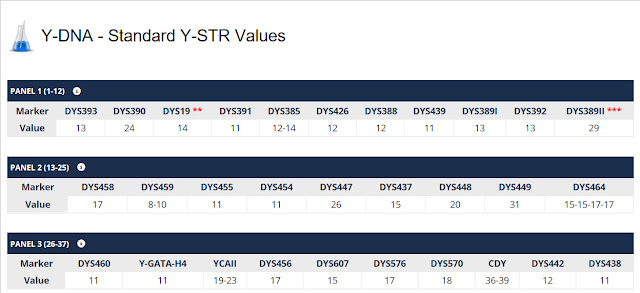
The Thompson DNA test was a 37-marker test, so Family Tree DNA examined 37 locations on the Y-chromosome and reported the number of repeats.
The first location was identified with the marker DYS393 which is DNA Y-chromosome Segment 393. At this marker the number of repeats was counted and reported--my brother had 13 Short Tandem Repeats at the location DYS393. Here are the complete results:
These results are meaningless unless they are compared to the results of other men. So in addition to your STR results you will get a list of matches.
 |
| Y-DNA STR results |
These results are meaningless unless they are compared to the results of other men. So in addition to your STR results you will get a list of matches.
You will also want to join a surname project so that you can compare your results with other people who share your surname.
I did all of that with the Thompson STRs, and that is how I found Electious Thompson's father. Now I want to go further back in time.
When you took your first test, Family Tree DNA did not do any SNP testing on your DNA sample; they only conducted an STR test.
The main difference between SNPs and STRs is their stability.
STRs can mutate back and forth. For example, in the example above we don't know which of the repeat values came first. Man 1 has CTA repeated 5 times, but CTA is repeated 6 times in Man 2's results and 7 times in Man 3's results.
SNPs
When you took your first test, Family Tree DNA did not do any SNP testing on your DNA sample; they only conducted an STR test.
So what's a SNP? SNP (pronounced "snip") stands for Single Nucleotide Polymorphism. It occurs when a single base (nucleotide) mutates. In the image below the ancestral nucleotide A has mutated to a T in Man 1. [See the fifth letter from the left.]
 |
| Image by Mark Jobling |
The main difference between SNPs and STRs is their stability.
STRs can mutate back and forth. For example, in the example above we don't know which of the repeat values came first. Man 1 has CTA repeated 5 times, but CTA is repeated 6 times in Man 2's results and 7 times in Man 3's results.
Which is the ancestral value--was it first a 5 that changed to a 6 in Man 2 and then a 7 in Man 3? Or was it first a 6 that mutated down to a 5 in Man 1 and up to a 7 in Man 3? Or was it first a 7 that mutated down in Men 1 and 2? There is no way to tell.
Furthermore, these not the only three options--STRs can mutate up in one generation and back down in another generation making two men look more closely related than they really are.
SNPs, on the other hand, are generally one-time events. When a SNP occurs it is passed down to all future generations. Some SNPs are proven to have occurred thousands of years ago. Others occurred in recent times.
SNPs, on the other hand, are generally one-time events. When a SNP occurs it is passed down to all future generations. Some SNPs are proven to have occurred thousands of years ago. Others occurred in recent times.
When a new SNP is found through Y-DNA testing it is given a name and placed on the human Y-DNA tree (called the haplotree). The name of this SNP becomes the name of a new haplogroup.
A haplogroup is simply a group of men who share a SNP. SNP testing is progressing so rapidly that SNPs occurring in the genealogical time period are being now placed onto the Y-DNA haplotree.
Based on the pattern of your STRs Family Tree DNA will predict an ancient haplogroup. Your haplogroup is your branch on the Y-DNA haplotree. Again, haplogroups are formed when two or more people share a SNP.
Haplogroups and SNPs
Based on the pattern of your STRs Family Tree DNA will predict an ancient haplogroup. Your haplogroup is your branch on the Y-DNA haplotree. Again, haplogroups are formed when two or more people share a SNP.
When I first logged into my brother's account many years ago, the haplogroup appeared in the upper-right of the screen.
In this example, the predicted haplogroup is R-M269. R-M269 is the most common haplogroup in Western Europe. It is also very old. Here's what Family Tree DNA reports about the age of the SNP R-M269:

To see where this SNP occurs in the human haplotree, the Y-DNA section of our account contains the following links:
When you click "Haplotree & SNPs" you will be taken to your predicted location on the Y DNA haplotree:
My predicted haplogroup of R-M269 at an approximate age of 25,000 years ago is not specific enough to help me find Robert Thompson's origins. But notice that there are many SNPs below R-M269 which will take me increasingly closer in time. The image shows only a tiny portion of the many SNPs that are downstream from R-M269.
If you took a test from 23andMe, you can get a more recent haplogroup than the one predicted by Family Tree DNA. Go to reports, then Paternal Haplogroup, This haplogroup, while not a modern one, has actually come from limited SNP testing.
Family Tree DNA offers three ways to do SNP testing. You can order a single SNP, a group of related SNPs (called a SNP Pack), or a test that will discover new SNPs in your Y-DNA (called the Big Y).
Before the Big Y test was available, I used to look at my matches who had done SNP testing and order a single SNP. Here is the result of a single-SNP test I took in 2012:
This brought my haplogroup closer to the present, but it can be an expensive way to go if I periodically order one SNP at a time.
 |
| Predicted haplogroup |
In this example, the predicted haplogroup is R-M269. R-M269 is the most common haplogroup in Western Europe. It is also very old. Here's what Family Tree DNA reports about the age of the SNP R-M269:

To see where this SNP occurs in the human haplotree, the Y-DNA section of our account contains the following links:
 |
| Y-DNA links |
When you click "Haplotree & SNPs" you will be taken to your predicted location on the Y DNA haplotree:
 |
| Y-DNA haplotree |
My predicted haplogroup of R-M269 at an approximate age of 25,000 years ago is not specific enough to help me find Robert Thompson's origins. But notice that there are many SNPs below R-M269 which will take me increasingly closer in time. The image shows only a tiny portion of the many SNPs that are downstream from R-M269.
If you took a test from 23andMe, you can get a more recent haplogroup than the one predicted by Family Tree DNA. Go to reports, then Paternal Haplogroup, This haplogroup, while not a modern one, has actually come from limited SNP testing.
 |
| Paternal haplogroup at 23andMe |
SNP Testing
Family Tree DNA offers three ways to do SNP testing. You can order a single SNP, a group of related SNPs (called a SNP Pack), or a test that will discover new SNPs in your Y-DNA (called the Big Y).
Before the Big Y test was available, I used to look at my matches who had done SNP testing and order a single SNP. Here is the result of a single-SNP test I took in 2012:
 |
| Single-SNP test refines haplogroup |
This brought my haplogroup closer to the present, but it can be an expensive way to go if I periodically order one SNP at a time.
When I first received my STR results this screen said, "Your Predicted Haplogroup is R-M269." Notice that this screen now says "Your Confirmed Haplogroup is R-DF13." Until further testing, this is considered to be my terminal SNP.
But I can now get much closer in time than that!
One way to predict your own haplogroup is to look at your matches in your surname project. In the surname projects the haplogroups are color coded. The ones in red are predicted haplogroups--the men with the red R-M269 have not done any SNP testing. The men with green haplogroups have been SNP tested.
Here's another way to find a more modern haplogroup than your predicted one. Check your list of matches and look at the Terminal SNP column. Two men were SNP tested for R-FGC11134.
So now we will join the R-FGC11134 Project to see if we can find other men who may be related more distantly than the Thompson Project members.
One way to predict your own haplogroup is to look at your matches in your surname project. In the surname projects the haplogroups are color coded. The ones in red are predicted haplogroups--the men with the red R-M269 have not done any SNP testing. The men with green haplogroups have been SNP tested.
 |
| Haplogroup project results |
Since the two descendants of Electious Thompson have matching STRs to the men who have been SNP tested, they probably belong to Haplogroup R-FGC11134 as well. This SNP is downstream of R-DF13.
The two men with the R-FGC11134 haplogroup tested with a SNP Pack. Below are the results from an R-M269 SNP Pack. This man was tested for the listed SNPs. He was positive for the ones that are followed by a + sign. From this test his terminal [most recent] SNP is considered to be FGC11134.
 |
| Results from SNP Panel test |
Here's another way to find a more modern haplogroup than your predicted one. Check your list of matches and look at the Terminal SNP column. Two men were SNP tested for R-FGC11134.
 |
| Y-DNA match list |
So now we will join the R-FGC11134 Project to see if we can find other men who may be related more distantly than the Thompson Project members.
Remember, we are trying to find the ancestors of Robert Thompson, and this will mean looking at other surnames to find clues to our European origins. Instead of working backward in time to find our common ancestor (as we did with STR testing), we now want to start with R-FGC11134 and work forward in time.
To join a project, log into your FTDNA account. Click Projects, then Join a Project.
Then scroll down to Y-DNA Haplogroup Projects.
R-FGC11134 will be found under the letter R.
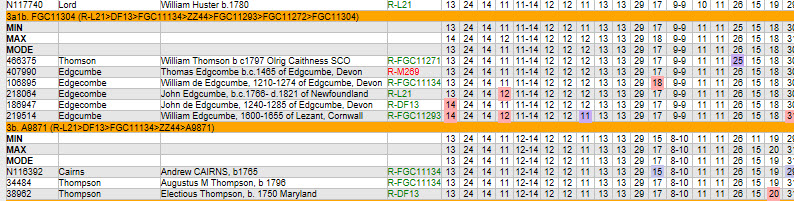
Once you have joined a haplogroup project, the project administrators will usually put you into a subgroup. Based on STR results, the FGC11134 Project administrators placed the two Thompsons with a man named Cairns. A man named Thomson was placed with a group of Edgecombes. Is this correct?
Cairns does not show up on my brother's list of DNA matches. Family Tree DNA has a set of cutoffs for what it considers to be a match. For 37 markers the match must be no greater than a genetic distance of 4, at 67 markers the match threshold is 7 and at 111 it is 10.
To join a project, log into your FTDNA account. Click Projects, then Join a Project.
 |
| Join a project |
Then scroll down to Y-DNA Haplogroup Projects.
 |
| Y-DNA haplogroup projects |
R-FGC11134 will be found under the letter R.
 |
| Join a Project |
Once you have joined a haplogroup project, the project administrators will usually put you into a subgroup. Based on STR results, the FGC11134 Project administrators placed the two Thompsons with a man named Cairns. A man named Thomson was placed with a group of Edgecombes. Is this correct?
 |
| Haplogroup project grouping |
The distance between Cairns and either of these two Thompsons is greater than the FTDNA threshold, and he also doesn't share the same surname. Only through the haplogroup project does he show as a potential match.
Cairns and Thompson share an interesting combination of STR results that are not seen in any other groups: these include 12-14 at DYS385, 8-10 at DYS459, and especially 11 at DYS438 [everyone else in the entire haplogroup project has a 12 in this position].
We know that Cairns and Thompson share a common ancestor because they share the SNP FGC11134. But could they be even more closely related and share some recent SNPs?
I suspected that based on the shared STRs they might share a few undiscovered SNPs. It turns out that Cairns had taken the Big Y test and had a long list of newly-discovered SNPS not shared with anyone else. Could Thompson and Cairns form a new haplogroup?
Testing with a single SNP or a SNP Pack cannot answer this question because these tests only look for known SNPs. On the other hand the Big Y is a SNP discovery test. It will look across the Y chromosome searching for both known and new SNPs.
It was time to stop messing around with single SNP testing and order the Big Y. Click Upgrade in the upper-right of your account screen.
All I can say is that I was blown away by what I saw when the results came back. Hang on! You'll next see why I say:
It was time to stop messing around with single SNP testing and order the Big Y. Click Upgrade in the upper-right of your account screen.
 |
| Upgrade test results |
All I can say is that I was blown away by what I saw when the results came back. Hang on! You'll next see why I say:
The Big Y test from Family Tree DNA can knock your socks off!
______________________________________________________
Disclosure
Links to Family Tree DNA appear in the sidebar. I receive a small contribution if you make a purchase, but clicking through the link does not affect the price you pay.